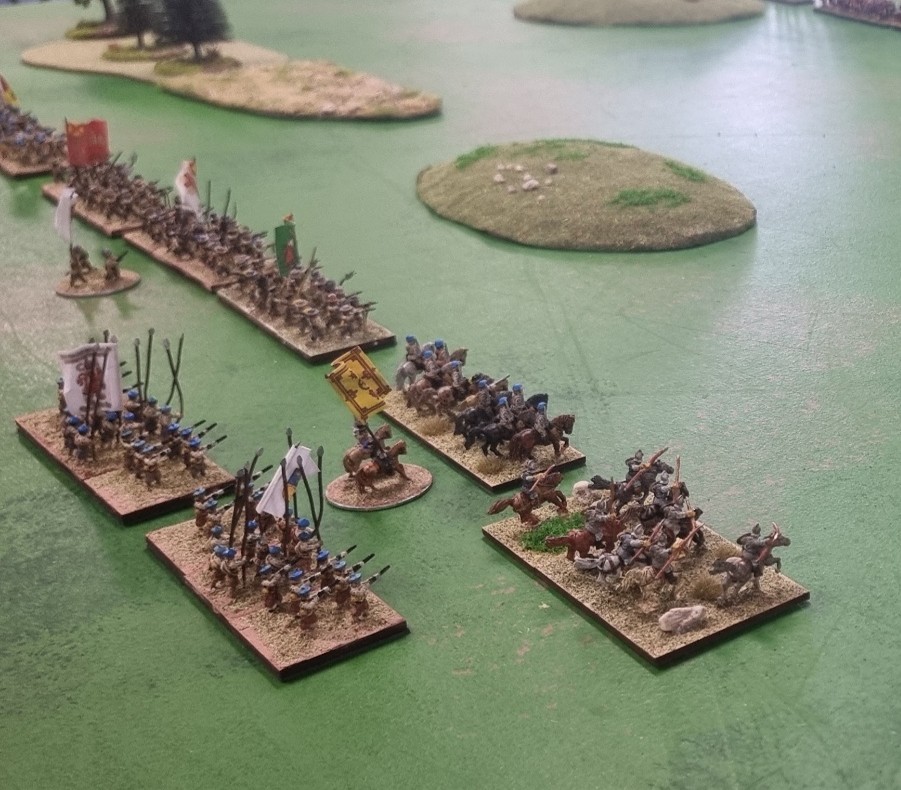
Baroque is another game from Dadi e Piombo (Lorenzo Sartori) in Italy and is focused on the late-16th and 17th centuries in Europe.
The general mechanics are similar to Impetus but there are some important differences, the most obvious being the 120mm wide bases (for 15mm figures). This gives the system a really authentic ‘pike and musket’ regiment look and feel.
As you would expect, there are also some differences in unit types and firing weapons. But there are also a lot of subtle rule changes, and I have found switching between Impetus and Baroque requires double checking which rule applies to which game.
For example, counter-charge in Baroque requires the units to meet halfway (in Impetus it is a 1BU advance for the defender), and there are many more minor differences. Unlike Impetus, in Baroque all units activate individually, not in groups.
The more we have played this at the club, the more I like the system and the way it represents the era, pushing players into making tactical doctrine decisions representative of the era.
The effective use of Pike and Musket (P&M) regiments depends on the unit quality (VBU), Impetus (I) and Discipline (D), as well as things like Fire Modifier (FM) and in some cases, melee modifier (MM). Players need to consider whether to advance, stand ground and exchange fire, when to open fire – save the first fire bonus (reroll misses) until close range (more dice) and risk getting shot up first (disordered and/or taking hits) or hit early and keep shooting; whether to move, salvo (for units with this capability), charge, taking negative modifiers on shooting for the sake of attempting to disorder enemy before closing with pikes (usually a better idea for high impetus and better discipline units); counter-charge (and getting impetus bonus) or defensive fire (usually good dice modifiers) – this decision can be more difficult in the face of a ‘potential’ charge (where the attacker may actually fall short). Just working out the approach while maintaining good order and sequencing attacks is a puzzle for players to solve.
Cavalry are represented by various unit types – gallopers (fast, often with lance), trotters (with point blank pistols), reiters (always with guns), light cavalry (sometimes with lance) and a few others.
How to use each type and when is another puzzle for players to solve. Charge, Fire, Evade, Wait and Join a continuing melee (sometimes good option for light cavalry), Countercharge or defensive fire (if armed with carbines). Generally low VBU units would avoid combat with higher VBU troops but light cavalry with lance can be very effective charging spent heavier units, particularly if accompanied by a leader (who helps in melee and the all-important discipline and cohesion tests).
Skirmishers require care as their low VBU makes them particularly vulnerable to evaporating should they be required to take a cohesion test. So generally, would avoid a firefight with formed infantry and also avoid getting run down by cavalry. That means using terrain and considering their specific purpose in the battle. Against other skirmishers it is a coin-toss who will survive.
Other unit types we have tried include Dragoons which seem to be very effective shooters and can hold up reasonably in melee. They are consequently quite expensive.
Of course, my Scottish Royalist army has the obligatory Highlanders – modest VBU, poor discipline, poor shooting modifier, very high impetus bonus. They also get special one melee ‘highland charge’ which impedes enemy defensive fire and cohesion tests. Use them wisely and choose the best targets and timing for the charge.
In Baroque, a successful defensive fire – one that causes permanent losses – automatically repulses a charge, so getting Highlander’s one shot at glory defused like this can be really annoying.
It is easy to get into this system. The rules are downloadable and inexpensive. Army lists are available online free of charge.
And Lorenzo is always happy to help and consider improvements to lists where you have good supporting historical rationale and evidence.
Lastly, a key attraction of this system, like Impetus, is the big bases which allow great dynamic arrangements of figures, especially cavalry.
If you have an ECW or TYW army looking for some action, feel free to reach out and we can organise a game among our growing group of players at NWA.