
Impetus Wargame Rules (Dadi & Piombo)
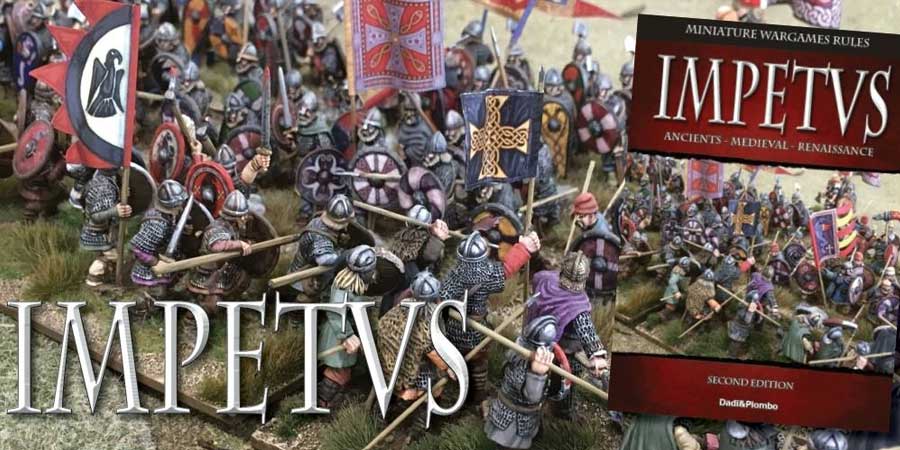
A few members have been playing these rules now for a few games and I thought I would provide some initial thoughts on the system. An important caveat is that I will need a few more games before being able to judge unit capabilities and tactics and thus offer a more comprehensive opinion.
Firstly, the rules are from Italian designer Lorenzo Sartori (Dadi & Piombo), who is very responsive and genuinely open for suggestions on improvements, particularly with regard to the army lists. The company has a sister game system, Baroque, which is for Renaissance and Reformation wargaming 1550-1700.
We started looking at Impetus because it was from the same stable as Baroque, and a system to plug the gap for those early renaissance armies – 1500-1550 – that fell between the cracks of ADLG and Baroque. However, it should be noted that Impetus covers a much broader period from ancients to 1550 although we have only used for the 16th century so far.
That being said, overall impressions are as follows. Note that I am comparing to ADLG, specifically because, as a relative newcomer to miniatures wargaming, it is the only other system with which I am familiar.
Big bases look good – 80mm frontage and variable depth. This works particularly well for cavalry units as the bases are considerably deeper than ADLG and allow for a very dynamic diorama.
Movement is quite restricted compared with ADLG. Which means you don’t see gamey complex manoeuvres. Units can move straight OR move sideways OR backwards OR obliquely (usually the last move of their activation) OR can wheel (but not move forward) AND risk disorder for doing a second or more moves in a turn. But you can only do one of the above per move.
Melee is really decisive – charge, counter charge, retreat, pursuit, continue melee. You can sometimes get stuck in melee (until someone else joins in) but mostly it results in a decisive outcome. And if you think of Alexander’s companions at Guagemala, breaking through several lines of enemy in one charge, you get the drift.
Shooting Units do well by shooting! Try and avoid being exposed to melee.
In all combat, the cohesion test CT is the critical decider – and the results are driven by: starting unit quality (VBU); losses to date; disorder!!!; and ‘hits’ scored by opponents (which effectively are a DR modifier for the CT).
Maintaining order is essential. Disordered units are prone to disintegrate quickly. No matter how good a unit is, once disordered, any ‘hit’ will result in a permanent loss and that can lead to disintegration of even the best units. Which brings me to the next point.
VBU is otherwise the dominant factor for all units as it relates to the amount of losses that can be accumulated and the number of shoot and melee dice the unit gets. You need to play it a few times to get how it works effectively. In every game, I’ve seen the best units get worn down and defeated – and that hurts as they cost a lot and count for a lot in army morale, sometimes contributing to collapse quite quickly.
The game system has good support and comes with a variety of scenarios, such as standard pre-set battles, fighting over terrain, rearguard actions, assaulting over a river and so on.
In standard battles, victory is determined through army breaking (as with other systems). In Impetus, wings break relatively easily and that can quickly cascade to armies breaking, so you need to plan carefully.
Overall, at this stage, it feels quite historical in the context of late mediaeval/renaissance encounters. But time will tell and I still haven’t worked out how to effectively use the different unit types.
The game can be played using multiples (brigades) of 40mm units based for other systems. But if you, like me, have armies that are specific to the 1500-1550 era then why not go ahead and take advantage of the big bases for visual effect!
So if you have some early renaissance armies gathering dust and pacing back and forth in their shoe-boxes or cake tins, maybe think about getting them back onto the table!
Baroque has the same design philosophy but has some significant differences relating to the later period. I will get to that system in another post.
